9.2.26
The Ocean Ecology Lab is hiring a postdoctoral scholar to study the population dynamics of marine mammals and their responses to climate change and environmental variability. We seek a quantitative ecologist with expertise in integrated modeling, time series analysis, and Bayesian approaches. Experience working with marine mammals and in marine systems is an advantage but is not required, and we welcome applications from researchers applying these methods to other marine taxa and terrestrial systems. Applicants should have substantial experience developing custom Bayesian models in languages such as Stan, Nimble or JAGS. Preference will be given to applicants with demonstrated experience developing integrated models that leverage complementary data types, building complex population dynamics models, developing hierarchical models for ecological time series, and/or quantifying environmental drivers of demographic rates.
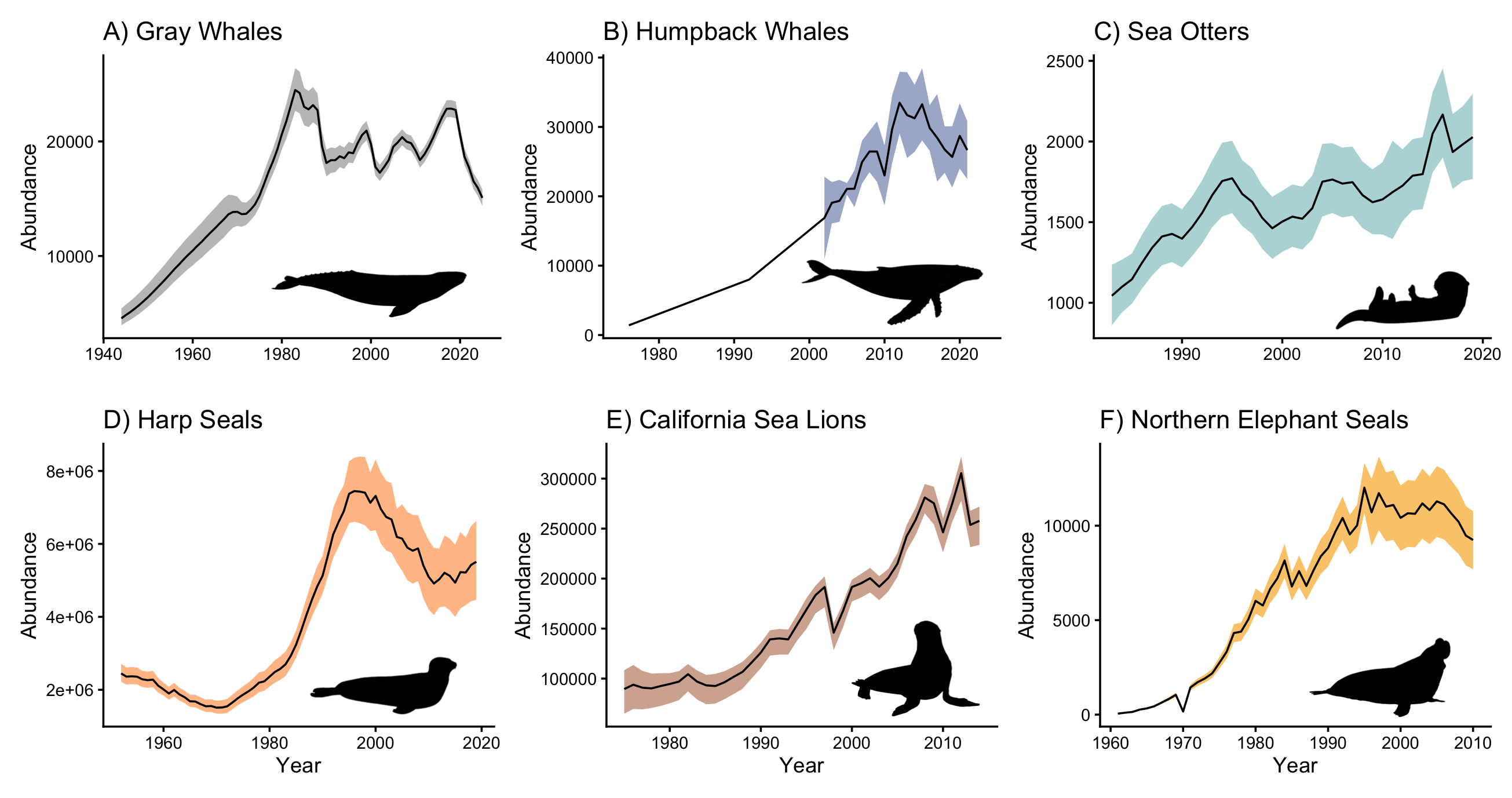
Marine mammals have undergone some of the most remarkable post-harvest recoveries of any taxa, in some cases rebounding from the brink of extinction to near carrying capacity in less than a human lifetime. As many populations recover to high abundance levels, we are gaining a rare window into how long-lived species respond to resource limitation, natural environmental variability, and accelerating climate change. Marine mammals offer a powerful model system for understanding density-dependent controls on vital rates, the dynamics of populations near carrying capacity, and the capacity of long-lived vertebrates to adapt to a changing climate.
The postdoctoral scholar will develop integrated population models to study long-term trends in abundance and vital rates of marine mammal populations. Topics of interest include how populations respond to environmental variability and change at different depletion levels; whether recoveries are being slowed due to climate change; what the primary sources of mortality are in recovered and recovering populations; and how adaptive behaviors translate into population dynamics. There will also be an emphasis on model development and methodological advancements. The postdoctoral scholar will have opportunities to work with other lab datasets on population dynamics, foraging ecology, and animal movement; assist with mentoring graduate students; and, if interested, contribute to teaching.
Postdoctoral scholars at Oregon State University receive a starting stipend of $63,480 with annual increases and competitive benefits (https://graduate.oregonstate.edu/postdocs/stipends-and-benefits). Postdoctoral appointments are renewed annually assuming satisfactory performance, and this position has funding for up to two years. To be eligible under OSU requirements, the postdoctoral scholar must have a PhD or equivalent at the time of appointment, and cannot be more than 5 years post-PhD during the postdoctoral appointment (for practical purposes, applicants should not be more than 3 years post-PhD for this reason). The position will be in-person at the Marine Mammal Institute (https://mmi.oregonstate.edu). The start date is flexible but will ideally be by January 2027.
To apply, send a single PDF titled Lastname_Firstname that includes: (1) Cover letter detailing your interests and applicable background; (2) Your CV; (3) Names and contact information for three references; and (4) One representative publication. In addition to the PDF, send a sample of clean, well-documented code from a previous analysis titled Lastname_Firstname_CodeSample. Materials should be emailed to Joshua Stewart (Joshua.stewart@oregonstate.edu) with the subject line ‘NAME - Population Dynamics Postdoc’.
Application deadline: September 30th.