The dynamics of recovering populations in a changing ocean
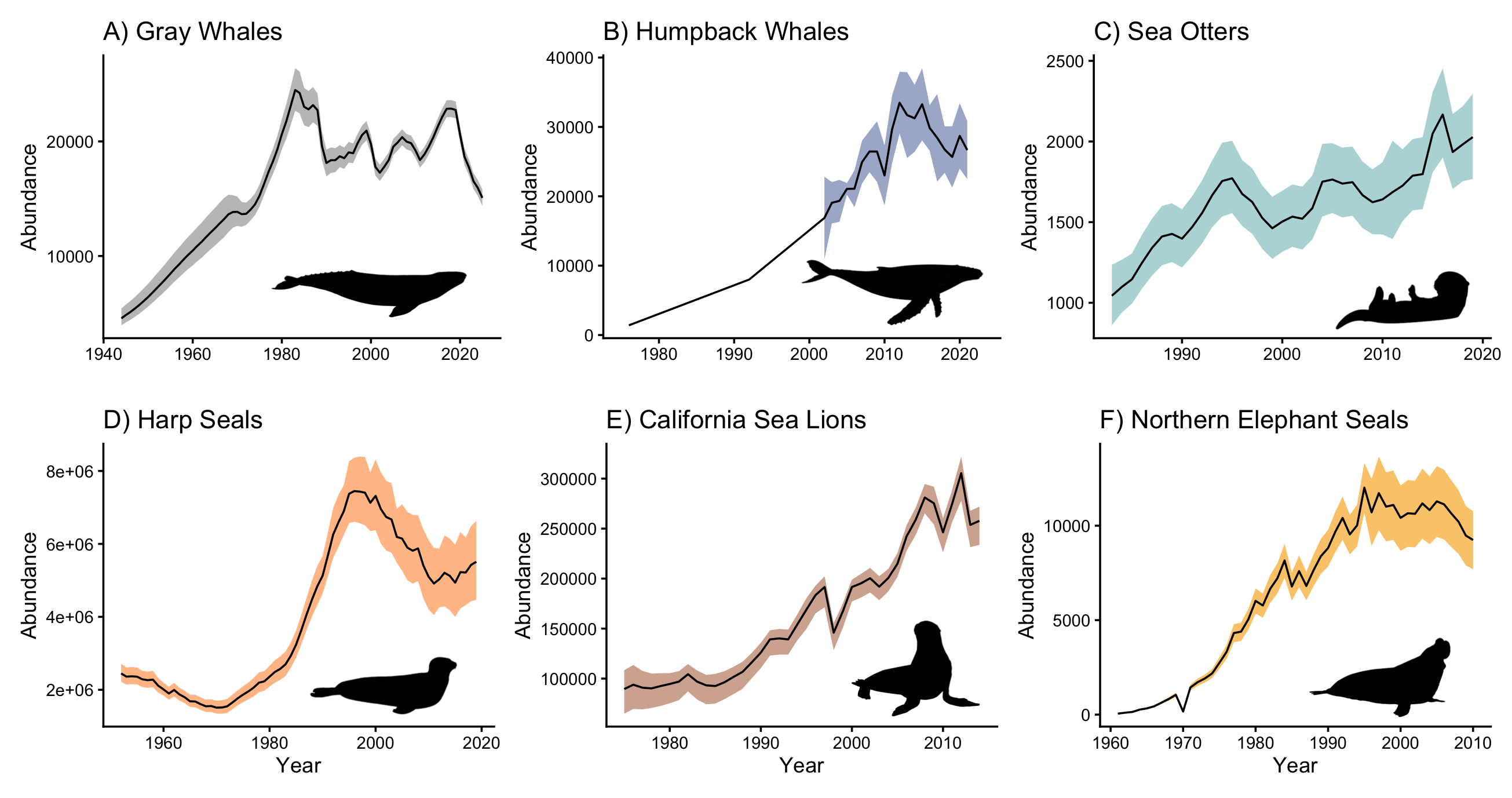
Many marine mammal populations have made remarkable recoveries from industrial harvest, in some cases rebounding from the brink of extinction to near historical abundance in less than a human lifetime. These conservation successes are providing a rare opportunity to understand the natural dynamics of large, long-lived vertebrate populations. Our research challenges conventional expectations that recovered populations will remain relatively stable near carrying capacity. Instead, we find that demographic variability can increase as populations recover and become increasingly constrained by food availability and environmental conditions. Periods of low reproductive output, elevated mortality, and even rapid population declines may therefore be natural features of recovered populations rather than evidence that recovery has failed.
At the same time, populations are recovering into oceans that are changing rapidly, raising fundamental questions about how density dependence, environmental variability, and climate change interact to shape population dynamics. Our work uses long-term datasets and quantitative population models to understand these interactions, with a particular focus on how environmental change affects prey resources, vital rates, mortality, and population resilience. Eastern North Pacific gray whales provide a striking example: despite their mobility and strong post-whaling recovery, changes in Arctic prey availability and access to feeding habitat have contributed to repeated mortality events and population declines of 15–25%. More broadly, we are interested in understanding when behavioral and demographic flexibility allows long-lived species to accommodate environmental change, when those mechanisms reach their limits, and how the dynamics of recovered populations will change as climate impacts accelerate.
Recent publications:
Boom-bust cycles in gray whales (Science)
The future of baleen whales (Science Advances)